by Omar Ha-Redeye and Jacob Kaufman
(from the March Issue of Nexus, Western Law’s Student Newspaper)
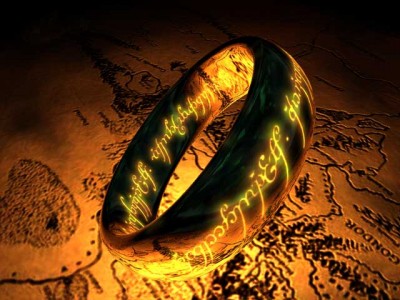 The novel The Lord of the Rings was a phenomenon. The movie trilogy based upon it has grossed over a billion dollars and won a slew of Oscars.
But what’s really interesting about the work is that it is about property law.
Seems Like a Property Exam
Consider the following facts which seem ripped from a first year property law exam:
- Sauron holds ownership in the Ring through accession, by working one thing (base metals) into a new thing (a ring of power)
- He is dispossessed by Isildur, who now holds possession in the Ring.
- Isildur loses the Ring (he has a manifest intent to exclude others but no physical control) when it slips off his finger as he was swimming in the Anduin river to escape from Orcs.
- Déagol finds the Ring.
- He is dispossessed by Sméagol (a.k.a. Gollum).
- Gollum loses the Ring and it is finally found by Bilbo.
- Bilbo gifts the Ring to Frodo. Later, Aragorn (the heir of Isildur) tells Frodo to carry the ring to Mordor, making Frodo his bailee.
- Sam, assuming that Frodo is dead, takes the Ring according to instructions to help Frodo with the Ring in grave circumstances. Sam is acting here as a (fictional) bailee and he returns possession to Frodo after finding him still alive.
- At the end of the book, Gollum restores his possession of the ring. Seconds later, he and the Ring are both destroyed. At this point all property held in the Ring disappears.
Hierarchy of Ownership and Possession
The Lord of the Rings story is that of a property hierarchy with one owner and a series of possessors.
Bilbo states,
[The Ring] is mine isn’t it? I found it.
He seems to be laying a claim of ownership through finding. But finding only lets a finder hold possession in a thing. It does not extinguish the rights of those higher up on the hierarchy.
In Anderson v. Gouldberg it was found that “possession is good title against all the world except those having better title.” It does not matter that several of the possessors of the Ring like Isildur and Sméagol obtained possession by violently dispossessing others. That circumstance does not change the dispossessor’s rights vis-à -vis a third party.
The fact that all parties subsequent to Sauron hold only possession in the ring is acknowledged in the text. When Gandalf forces Bilbo to give up the Ring, he tells him to,
[s]top possessing [the Ring].
After discovering that Aragorn is the heir of Isildur Frodo exclaims that the Ring really belongs to Aragorn. Aragon corrects him:
It does not belong to either of us, but it has been ordained that you should hold it for a while.
Frodo later elaborates that the Ring,
does not belong to any mortal – though if any could claim it, it would be Aragorn.
Here he demonstrates his understanding of the property hierarchy – with Sauron at the apex as owner and Aragorn as next highest as a descendent of the first possessor after Sauron.
Aragorn’s Claim
What claims can Aragorn make that he is the rightful owner?
Isildur claimed the Ring as weregild for the death of his relatives at Sauron’s hand.
As Professor Gwen Seabourne notes this is,
compensation for the kin of the slain in respect of a (wrongful) killing.
If a claim in weregild is upheld then Aragorn would hold ownership of the Ring. The Ring, however, is shown to have Animus Revertendi as it seeks to return itself to Sauron.
Would this cut against a transfer in weregild? Canadian Courts have, so far, not ruled on how the intrinsic characteristics of magical items demonstrate who holds what property in them.
Another claim that Aragorn could make is that Sauron’s ownership of the ring elapsed due to abandonment.
Simpson v. Gowers defines abandonment as a “giving up, a total desertion, and absolute relinquishment.” Sauron did believe that the Ring was gone forever, which would support the idea that an abandonment occurred.
Asessing a Claim of Abanonment
Stewart v. Gustafson sets out four factors to further help determine if property has been abandoned:
- Passage of Time: As the years go by, the likelihood of abandonment increases. In this case 3000 years passed, which is a not insignificant lapse of time.
- Nature of Transaction: Certain transactions lend themselves more to assuming abandonment, having objects cut off your hand does not appear to be one of them.
- Property Holder’s Conduct: Abandonment can be inferred if a property holder does not try to require possession a reasonable time after receiving notice. After finding that the Ring was still attainable, not only is Sauron trying to retake possession but he is described as “seeking it, seeking it, and all his thoughts [are] bent on it.”
- Nature of the Thing: As the value of a chattel increases, the likelihood of inferring abandonment decreases. The extreme value of the Ring (it could be used to conquer all Middle Earth) cuts against an abandonment. The specific nature of the Ring also cuts against abandonment. Gandalf specifically states that “[the Ring’s] keeper never abandons it”.
It appears to be that the evidence points to no abandonment having occurred.
However, it seems likely that 3,000 years well exceeded the limitations period.
Therefore, Sauron has lost his right to legal recourse.
As far as Canadian law goes however he would still have a self-help remedy, which he apparently exercised by sending the Nazgûl to seize the ring.
Updates
- Ilya Somin, Assistant Professor who teaches property at George Mason University School of Law, adds some notes to this story at the Volokh Consipracy,
In addition to the primary property dispute over the ownership of the Ring, there are several other conflicts over property in the Lord of the Rings, such as the claim of Rohan’s neighbors that the Riders wrongfully disposessed them of their land, the conflicting claims to ownership of Moria as between the Dwarves and the Balrog, and Aragorn’s claims to inherit the lands and other property of his ancestor Isildur. The chapter on “The Scouring of the Shire” with its scathing portrayal of Saruman’s “Gatherers and Sharers” and Saruman’s nationalization of industry is a thinly veiled attack on socialism. None of this is to say that Tolkien was some kind of libertarian. He hated modern industry and capitalism. But he did have a conservative traditionalist’s attachment to private property, and it comes through in the book at many points.
- Be sure to check out the comments on his page as well, including IP claims laid by the Elves.
- Although David Colborne says this post is “geeky as hell,” Avierra of The Floating World retorts, “hot nerds are so very hot” (you should see us in wool suits in the summer). She then point out that Heidi Bond, a Michigan law student, has reviewed offer and acceptance in the LOTR context.
- John C. Wright raises issues of intestate and inheritors.
- K-wat raises international jurisdictional issues (we use Canada because that’s where we live, though common law principles are similar)
 This is a reformatted article from a previous post. Acknowledgement is provided to Prof. Adam Parachin, who teaches first-year Property at the University of Western Ontario for the initial inspiration of these posts.
Mark–
Setting a middle earth wide statute of limitations is difficult for the reasons you mention. There’s lots of entities with very long lifespans (maiar, elves, ents…) But the majority of the popluation is composed by beings like dwarves, elves, men and orcs who live quite shorter lives. If the statute of limitations catered to immortals then it would effectively not exist for the majority of residents.
Steve–
I don’t think that law of treasure troves would apply. As Weeks v Hackett states treasure-trove applies where “the owner of the discovered treasure being unknown.”
FLS–
Great point! Plus both this case and South Staffordshire are about property in gold rings which is pretty cool. Ultimately though, I think it’s just guilding the lily. Sauron has a perfectly good claim in ownership without having to jump through the hoops of proving that the ring was a fixture (there is a difference in the type of water) and that he actually had control over that part of the Anduin River at that time.
someone mentioned orcs as grouped under ‘short’ lifespan poeples. I believe that orcs live nearly as long as Elves, providing they are not killed, which admittedly happens alot-but I thought that that Bolg, the son of Azog, who conquered Moria, was leading the orcs at the Bttle of Five Armies. since there are certainly more orcs than anything else, and since they appear to be long-lived, wouldnt that mean that time periods of less than 10,000 years should be considered relatively short? also, there is the similar case of possession of the rule of Minas Tirithe by the Stewards. Boromir once asked his father how long the stewards would have to wait until they could claim to be a new line of Kings. Denethor stated something like ‘for a lesser fieifdom, 1000 years would suffice, and more, but for a realm as great as Gondor, not even ten 10,000s would be even close to enough. Since the value of the Ring would be at least as much as the value of Gondor, even when it was ruled by Isildur at the height of its greatness, then wouldn’t the Ring probably need to be ‘lost’ for close to 100,000 years before someone other than Sauron could Claim it? Even supposing the ‘weregild’ claim of Isildur, I think that the value of the life of a great King would not be worth more than the deed to Barad-dur, which was destroyed in the war of the Last Alliance, so the next best thing would be something like the Ring of the Witch-King.
But before I digress into all the possible substitutes for a weregild, isn’t this enough, especially considering the ownership laws implied in the Stewardship of Gondor, to prove that 3000 years is not enough time for the Ring to be lost for someone else to Claim it?
Green Lensman–
I think that Tolkein went back and forth on the livespan issue for orcs. There are some statements that hint at Orcs having the possibility of long lifespans and others that are the reverse. But regardless, the life of the average orc is going to be nasty, brutish and short. Therefore even if its possible some orcs live a long time (though Bolg was only, like, what a few hundred years old?) the average does not approach the 10,000 range (I would guess not even the 1000 year range or 100 year range). So I still think the statute of limitations should not cater to immortals.
The analogy with Gondor is a neat one– it seems that we agree that no abandonment occured and that’s another good reason why abandonment should not be inferred.
I’m sure that when contesting the weregild claim Sauron would bring up that giving something as valuable as the Ring would overcompensate Isildur for the deaths of a couple of mortals. Though, is the Witch-King’s ring really the next best thing? Going from a Ring to rule them all to a ruled ring seems like a bit of a demotion. Personally, I’d rather take something like a herd of mûmakil and a lot of gold.
Good post. You make some great points that most people do not fully understand.
“In Anderson v. Gouldberg it was found that “possession is good title against all the world except those having better title.” It does not matter that several of the possessors of the Ring like Isildur and Sméagol obtained possession by violently dispossessing others. That circumstance does not change the dispossessor’s rights vis-à-vis a third party.”
I like how you explained that. Very helpful. Thanks.
I would like, if I may, to offer a comparative case from Texas as to the cause of self help. Though frequently allowed, it is limited in that there must be no breach of the peace in the action taken and that if there is any such breach by any party involved, that the fault is laid against the party initiating the self help action (MBank El Paso v Sanchez 836 S.W. 2d 151 (Tex. 1992)). Levying war against Gondor and Rohan and the world in general, and the pursuit of Frodo in particular, would thus count as breach of the peace. While not necessarily severing Sauron’s right to the Ring, it would mean that he would be liable for all damages accrued in its pursuit.
As to the question of Sauron’s death, he was merely deprived of his physical body for a time. The Maiar race does not need a body in order to exist or even to act, they merely clothe themselves with bodies as we humans do in raiment (see Silmarillion). Further, Maia can have children and spousal relations as is evidenced by the case of Melian and Thingol, Maia and Eldar, respectively, parents of Luthien, one of the ancestresses of Aragorn. When Thingol died, Melian cast off her physical form and returned to the West, still very much alive in all senses that mattered to a Maia. Mere deprivation of a physical form is not death in this case. I am not sure if such a spirit can really be destroyed in Middle Earth or in this Earth, and this will undoubtedly complicate testamentary law if ever brought forward.
Sauron is indeed a Maia and all the other Maiar are considered his brothers and sisters, though we do not know which is eldest or who would be closest. His own master, Melkor, was dispossessed long before the events in question, thrust out of the world, and so likely could not even make a claim as feudal overlord on purely jurisdictional ground. As such, the putative father/creator, Eru, is likely the most proper testator. If it did escheat to the Crown, it would not necessarily be a mortal Crown but that of the immortals, Sauron’s race, Manwe being the chief among them. Manwe, though of the Vala, still holds dominion because the Maia are of the same sort as the Vala, merely lesser in stature.
I would think that after 1000 years, Denethor could logically claim to have the right to assume the kingship. Consider the case of the start of the Carolingian dynasty wherein the pope ruled that whoever acted the part of the king should be the king, thus leading to the recognition of Pepin the Short. So, if Gondor is a much greater realm, then the analogy should still apply and the kingship should be assumable after the passage of 10000 years. But then the story is largely treated as apocryphal, and may not be considered binding.
hi , im from iran , when i saw this fiml [the lord of the ring ], i was going to be crazy ,i never have seen better than this film ,i just can say to director your work is fantastic and i love you,good luck ,bye
I used to post as Green Lensman. In case that interests anyone. :?
Anyway, it seems pretty obvious to me that the ownership claim of abandonment must be… abandonned (rimshot).
Sauron most certainly didn’t abandon it, it was cut off his hand. Isildur didn’t abandon it, he was killed and it *dropped itself, but he didn’t intend to lose it- he is quoted by Gandalf as having left a record in Gondor’s archives that it would be ‘an heirloom of his house- weregild for the deaths of Elendil his father and Anorien his brother’
That shuts down Gollum’s claim, and the moreso Bilbo’s after Gollum’s reaction: going EVEN insaner and beating the freakin’ NAZGUL @ finding it and RETRIEVING IT!!! Sure he got burned up and sent to hell yadayada, but come on- if YOU’D just beaten the 9 Undead Kings of the Lord of the Rings at Hide and Seek and Rule the World, wouldn’t you celebrate? ;D
That leaves the weregild claim of Isildur- and Aragorn’s claim as his heir. Only if Isildur’s claim stands can Aragorn justify passing it to Frodo, or permit Gandalf to permit Elrond to permit…etc. the point is, The Fellowship itself is illegal, since its purpose was to protect a right that was not justly held (possession of the Ring by Frodo)
As far as a weregild claim goes- not only could Isildur claim simple relationship, but as the leader of a world power, and member of the Last Alliance-which means he could easily also claim weregild on GILGALAD the HIGH KING OF THE NOLDOR, the Highest Elves in Middle Earth.
That might qualify for compensation as great as a Ring of Power; but in my opinion still not the One, since that would imply an extension to ownership of ALL the Rings: “One Ring to Rule Them All…”
But the lives of at least 2 Numenoreans of Gondor’s Royal Family, the Leaders of BOTH elven races that had kings- (Oropher fell at the Black Gate-he was Legolas’ grandfather; Rivendell and Lorien would have been subject to Gilgalad)…
that would be worth, at least one of the Seven, and definitely the return of the Palantir of Minas Ithil…and throw in the absolvment of any claim made any ally or servant of Sauron to lands outside the Mountains of Mordor, exempting those held by the Haradhrim and the Easterlings (targeting Orcs here)
Isildur, though, definitely has some justification in claiming some sort of Weregild from Sauron for the deaths of the nobles of the Alliance during that war; Sauron has a greater right to keep the ring, and in case anyone wants to ask about corporeal stewardship during his ‘shadow years’- it can only be either the Mouth of Sauron, who would have replaced Sarumaan had the Ring been recovered (see ROTK), or the Witch-King himself-slain on the Pelennor Fields, then it passes to the next highest Ringwraith, who was actually of all the Nine given a name-Khamul:he was a Haradrim, and called the ‘Shadow of the East’
It seems implied by including both the character of Khamul in supplemental writings, and the Mouth of Sauron at the Black Gate, that indeed Tolkien MEANT to show a full line of succession/heirs for Sauron’s claim! But I just realized that since either way Sauron gets the Ring, then all the other thousands of words I wrote dont matter because we should all be under the Dominion of the Land of Shadow.
Does Mordor’s Constitution have the Right to Free Speech?
Does it HAVE a Bill of Rights?
Do the orcs even get a Constitution?!?!
It’s possible that this forum has justified its own destruction, which would mean that it might have been ironically better if we had never spoken up. lmao.
good thing Middle-Earth is not the real world, or we would all be screwed –> Sauron has the right to own a thing which he invented that allows him the rule the world. Right to revolt now translates to right to commit suicide if he regains the Ring, since no revolt could possibly succeed. Unless somehow abuse of power could justify a legal injunction, like a Declaration of Independence. only written in Elvish?
“seem ripped from a first year property law exam.”
In fact, I gave this question – – disputes over property rights in the One Ring – – on my actual Property Law exam at Duke Law School back in April 2004. My question was designed to be answerable based on the key events it recounted, without further knowledge of Tolkien’s Lord of the Rings books. Students enjoyed it, and they offered creative answers.
Maybe the authors of this entry “borrowed” their idea from my exam? Or perhaps it’s a case of independent inspiration.
– JBW
Law is Cool: As noted in the original linked article, inspiration for this post came from one of our own Properly law professors who mentioned it in class. It is quite possible that he got the idea from you. Thanks for letting us know.
This came up in a Usenet discussion thirteen years ago:
http://groups.google.com/group/misc.legal.moderated/browse_thread/thread/a0e5dd3b42d755c3/e7dddeff8953dcc3?q=%2Bsmeagol+%2Bbrennan
Fans are flooding to the official jtolkien.com website.
First Published in October 2008 edition of The Docket, the Georgia State University College of Law Student Newspaper:
By: Robert Bexley
Frodo Baggins v. Sauron, (Mrdr. App. Ct. 2008).
The case at bar is one between the estate of Mr. Sauron, Plaintiff and Mr. Frodo Baggins, Defendant. Plaintiff brought suit alleging that Defendant had intentionally destroyed a valuable family heirloom of the decedent. The trial court denied demurrer for Defendant, and the jury awarded Plaintiff $200,000 in nominal and punitive damages. Defendant appealed, stating trial court error in denying demurrer.
The facts go back 650 years. Mr. Smeagol Gollum, a hermit and schizophrenic, misplaced his gold ring. While spelunking in a cave, Bilbo Baggins, Appellant/Defendant’s uncle, found the ring.
Upon returning home, Mr. Baggins kept the ring safe and on his nephew’s eleventy-first birthday, conveyed the ring to him. Appellant, Frodo Baggins, learned that the ring in fact belonged to Mr. Sauron of Golgoroth and instead of returning the ring, Appellant was told by his counsel, Mr. Gandalf Mithrandir, Esq., to destroy it in Mount Doom. The facts of the trial court are unclear as to why this course of action was necessary.
Appellant snuck into Mordor and ascended Mount Doom. Upon reaching the summit, however, Mr. Gollum approached Appellant insisting upon the return of the ring. Appellant refused and hit Mr. Gollum on the head. Immediately before throwing the ring into the fiery depths of Mount Doom, Appellant had a change of heart and put on the ring so he could safely return it to Mr. Sauron. Mr. Gollum awoke furious and bit off the finger of Appellant on which the ring was placed. Appellant then pushed Mr. Gollum over a cliff into molten lava, destroying the ring, Mr. Gollum, and oddly enough, Mr. Sauron.
Despite the horrors of Appellant’s actions, the case at bar is only concerned with the destruction of Plaintiff/Respondent’s property.
There is a doctrine in Torts that justifies the actions of a person, when acting in good faith; he may destroy another’s property in the best interest of the community as long as the necessity is clearly shown. In Surroco v. Geary, it was necessary to raze a house in order to save adjoining homes and thus the city from an oncoming blaze. The court found the defendant not liable for destroying the plaintiff’s home because he was acting in the public interest, even by good faith mistake.
Mr. Baggins was under the impression that he was protecting the public interest by destroying the so-called “One Ring to Rule Them All.†We hold that pushing an ancient malnourished lunatic into magma to destroy a ring is conduct reasonably necessary to protect all of humanity. As such, we find that the trial court erred by denying Appellant’s demurrer. We reverse the trial court’s ruling and hold Appellant not liable for damages to Respondent’s property.
(omitted, Saruman, J., dissenting.)
*Maybe the authors of this entry “borrowed†their idea from my exam?*
As their is no ownership in an idea, there is no possibility of theft, no need for the fiction of borrowing. Information wants to be free.
Law is Cool: As noted, this is an entirely original entry, aside from the idea being brought up in in property law class. It was researched and drafted without any knowledge of others who have attempted a similar analysis in the past.
Any resemblance to existing property law exams is coincidental – but we encourage those who have done similar work to share it here.
It seems we would also have a severe conflict-of-laws dispute here.
A few of the possible issues this would give rise to:
If decided under the Law of Mordor, a realm generally recognized (if loathed) by the other realms of Middle-Earth. As dictator, he could serve as judge and jury in his own case, and the counsel for the opposition would be at a disadvantage as the fairer races consider it an ill omen for the words of the Black Tongue (the official language of Mordor) to be spoken aloud. Of course, following his defeat, Sauron and the Realm of Mordor exist only in pretense.
Aragon, as King Elessar of Arnor, Gondor, and High King of the Reunited Kingdom, could claim sovereign immunity if suit was brought under the laws of these realms.
Additionally, the One Ring traveled and changed possession in a variety of realms – including various modern States, city-states, and private domains (Principalities? I doubt any state would presume to claim Tom Bombadil’s land, yet his “country” consists solely of his home and the surrounding environs) – and the various claimants and the locations where possession begin and end occur in different countries as well.
This is complicated by the fact that the legal schemas vary widely from place to place – consider, for instance, the nature of the inhabitants of such varied locales as the Shire, Rivendell, Fangorn Forest, and the Lonely Mountain (either before or after the return of the King Under the Mountain and the demise of Smaug) and how the legal regimes would reflect such varying natures.
@Robert Bexley. Very nice! However, while it notes the role of Gandalf as counsel, it forgets to mention his recusal from the deliberations in this case.
That Saruman would dissent rather than likewise recusing himself only goes to show what kind of person he is. Hopefully he’s impeached before he further damages the court’s credibility.
Have you made any inquiries to the forging of the rings? Wasn’t Sauron at the time of the Ring’s creation an employee or independent contractor of the Elven smiths of Eregion? Does its design count as intellectual property? If so, should the smiths, or their heirs, be the rightful owners? What would happen if the smiths could produce a Sauronian promise not to compete? Again, if so, would they become the rightful owners? At the time of this relationship, Sauron disguised as Annatar, “Lord of the Gifts”, thus working under false pretensions. Furthermore, I’m guessing Sauron didn’t have a work visa since he had broken his parole from the Valar and fled that realm. Also, since Sauron’s intent was to defraud from the outset, can he gain/profit from his illegal activities? This would seem to be against the public interest. For reference, the Three were completed c. S.A. 1590, with the One bieng completed ten years or so later c.1600.
Wow. Not sure how I dint come across this conversation when was reading the lord of the rings. Awesome book. Frodo, Sam, Aragon, Gandalf….
And sorry for interrupting but this was an interesting read :)
Cheers
Wow, that is impressive. I must say I am going to have to sit down and watch the Lord of the Rings again and view it from your perspective. I’m curious, how many times did you watch the movie before coming up with this idea?
Terrific the job! That is the body on answer that should be shared past the web. Shame in the search the web engines for never positioning things like this content higher!
We appreciate you the aid!Thanks a lot plus This best regards! Many thanks and also Im sorry intended for countless questions nevertheless i must say i want a persons aid.
Me and my partner really much loved it write-up, we are standing straight down right now to a cup of tea and talking with the laptop computer beside us. Just most questions: Once did you get into blogging? How considerably is internet hosting per few weeks? How significantly are you reeling in per 30 days? How many visitors do you normally get? Have you learned any big triumph tales with folks blogging? Appreciated, we’ll be checking back but you can e-mail us aswell.
An interesting way of looking at things! I dont think I will watch the film in quite the same way!
I don’t think any of this matters. The ring is a living organism, with a mind of its own- giving it a right to freedom.